
What Germany’s Famous Motorways Are Really Like
Distinguishes fixed, variable and unrestricted sections, explains the 130 km/h advisory speed, and covers lane discipline and emergency corridors.
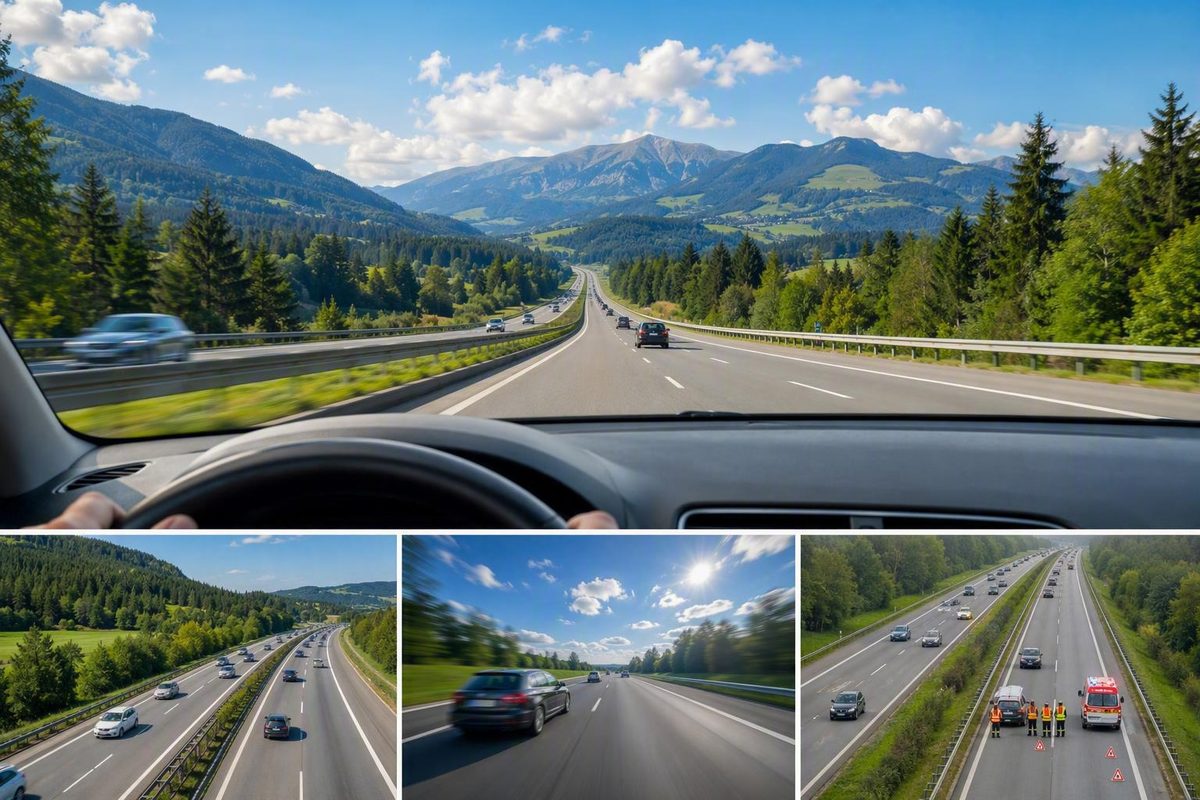
Germany’s Autobahn has acquired a misleading shorthand: the road where speed limits do not exist. That image contains one narrow truth—some sections have no general mandatory maximum for qualifying vehicles—but turns it into a false description of the whole system.
The Autobahn is not a racetrack or one special road. It is a controlled-access motorway network governed by displayed restrictions, lane-use rules, emergency procedures and changing traffic conditions.
For a first-time visitor, the useful question is therefore not “How fast can I go?” It is “What applies here, right now, and how can I remain predictable?” That distinction makes the Autobahn less mysterious—and considerably less sensational.
This guide summarizes the supplied evidence rather than replacing current German law, police instructions, rental terms or insurance conditions. Several operational sources are motoring or commercial guides rather than German authorities, so legal, equipment and toll details should be confirmed before travel.
What the Autobahn is—and what the name actually means
“Autobahn” is the general German word for a motorway, not the name of a single road. Germany’s federal system is formally called the Bundesautobahn, commonly abbreviated BAB. Individual routes receive an A followed by a number: A1, A3, A8 and so on.
It is a nationwide network of controlled-access roads. Its basic design includes divided carriageways, separation between opposing traffic, grade-separated junctions and access through designated entrances and exits. Unlike an ordinary urban or rural road, its main carriageway is not interrupted by conventional crossroads or traffic lights. A 2025 CNBC report describes the Bundesautobahn as a limited-access system with designated entrances and exits and no ordinary intersections or traffic lights.
It does not eliminate danger.
Access is limited to suitable motor vehicles, but travelers should not infer that every powered vehicle qualifies. Vehicle category, capability, towing configuration and other details may matter. The available evidence does not establish a complete, current eligibility rule for every vehicle, so drivers should check current German requirements and their rental agreement before using the motorway.
Published sources also disagree about the network’s exact current length. The differences may reflect dates, definitions or methodology. An apparently precise total would therefore imply more certainty than the evidence supports. The practical point is that the Autobahn is a large national network of many A-numbered routes, not one uninterrupted high-speed road.
Most importantly, the blue Autobahn sign does not mean that every speed restriction has ended. It marks entry into a controlled-access motorway regime. The applicable speed still depends on the vehicle, displayed signs, overhead signals and conditions.
The no-speed-limit myth: restricted, variable and unrestricted sections
Germany’s Autobahn combines three broad operating situations:
- Fixed mandatory limits, displayed on roadside signs.
- Temporary or variable limits, including construction restrictions and limits shown electronically.
- Sections without a general mandatory maximum for qualifying vehicles, where the advisory speed remains relevant.
The proportion in each category should not be presented as a definitive current percentage. Available estimates use different dates, scopes and treatments of roadworks or variable controls. The reliable conclusion is that both restricted and unrestricted sections are substantial features of the network, and a single journey may pass through several different regimes.
A number inside a red circle indicates a mandatory maximum. A speed displayed by an active overhead control system should likewise be treated as binding while it applies, even if the road was unrestricted moments earlier. Such restrictions may be associated with congestion, rain, construction or other changing conditions. The RAC’s July 2025 Autobahn guide distinguishes unrestricted stretches from fixed and traffic-controlled limits and identifies 130 km/h as the advisory speed on unrestricted sections.
That 130 km/h figure is the Richtgeschwindigkeit. It is not a universal statutory maximum, and driving above it on an otherwise unrestricted section is not automatically the same as violating a posted limit. It is equally not a target that every driver must reach.
Calling the Richtgeschwindigkeit “advisory” does not make it meaningless. Secondary motoring sources report that exceeding it may become relevant when civil responsibility is assessed after a collision. They do not establish that every driver above 130 km/h is automatically liable, nor do they provide a universal formula for allocating responsibility. The result depends on the circumstances and should not be predicted from a general travel guide.
There is also a more immediate constraint than any sign: what the situation safely permits. Rain can reduce grip and visibility. A truck may begin overtaking. Traffic can compress beyond a bend. A driver may be tired, or a vehicle may be unfamiliar or heavily loaded. A posted maximum is not a promise that traveling at that speed is prudent.
The practical hierarchy is straightforward:
- Obey every applicable displayed restriction.
- Observe any rule applying to the vehicle or vehicle combination.
- Reduce speed further when traffic, road, weather, visibility, vehicle condition or personal readiness requires it.
- Treat 130 km/h as a meaningful reference on genuinely unrestricted sections, not as an invitation to test the car’s maximum speed.
How to read changing limits and road conditions
Autobahn driving requires continuous sign-reading. Do not enter a route, see no immediate limit and assume the next stretch will remain unrestricted. Watch roadside signs, overhead gantries, lane-specific signals and temporary traffic management throughout the journey.
Consider a simple example. You are traveling on a section with no displayed mandatory maximum. A gantry ahead illuminates 100. From the sign, 100 km/h becomes the applicable maximum while that restriction remains in force.
Early observation makes the transition safer. Looking far ahead allows a driver to release the accelerator and reduce speed progressively rather than brake sharply near the gantry. Check mirrors before slowing and avoid sudden lane changes in search of a faster line of traffic.
Limits may change in stages: 120, then 100, then 80 km/h when approaching congestion or roadworks, for example. Conversely, the end of one restriction does not cancel vehicle-specific rules or guarantee that immediate acceleration is appropriate. Read what is displayed instead of copying the fastest nearby vehicle.
Electronic controls matter because they can respond to current conditions. A familiar stretch may operate differently on another day—or later the same day—because of traffic, rain, an incident or maintenance.
At roadworks, RAC guidance states that temporary yellow markings take priority over permanent white markings. It also describes posted and overhead speed restrictions as applicable controls. Because RAC is a British motoring organization rather than the German rule-making authority, visitors should confirm current requirements before driving and follow police or road-operator directions at the scene as summarized in its German Autobahn guidance.
When a restriction or temporary layout is unclear:
- Reduce speed smoothly.
- Hold a stable lane unless a move is clearly necessary.
- Follow the more restrictive visible instruction.
- Continue checking for lane-specific signs, confirmation or the end of the restriction.
- Do not make an abrupt maneuver merely because another driver reacts differently.
The word “Autobahn” is also used in Austria and Switzerland, but that does not create a shared legal system. Speed rules, tolls, vignettes, equipment requirements and enforcement vary by country.
Before departure, check current German information together with the rental agreement and insurer’s terms. Confirm licence documentation, motorway eligibility, breakdown procedures, supplied equipment, cross-border permission and any contractual limits on vehicle use. These are current legal and contractual questions, not details to settle from memory.
Lane discipline: keep right, pass left and plan every move
The right lane is the normal travel lane, and lanes to its left are used for overtaking. After passing, return to the right when there is a safe gap rather than remaining unnecessarily in a center or left lane.
The principle is simple; judging closing speed is not. A vehicle that appears distant in the mirror may arrive rapidly, particularly on an unrestricted section. One glance is insufficient.
Use a deliberate passing sequence:
- Observe early. Check the interior and relevant side mirrors repeatedly.
- Assess closing speed. Consider not only whether a vehicle is present, but how quickly the gap is shrinking.
- Check the road ahead. Make sure there is enough room to pass without forcing another driver to brake.
- Signal clearly. Indicate before moving rather than after the maneuver has begun.
- Move left smoothly. Avoid sudden steering.
- Complete the pass. Maintain control and an appropriate speed.
- Return right safely. Leave a suitable gap instead of cutting closely in front of the vehicle passed.
Secondary driving guidance consistently describes keeping right, overtaking on the left and returning right after the pass as the normal Autobahn pattern. It also says overtaking on the right is generally prohibited, with limited exceptions in slow-moving traffic that a brief visitor guide should not attempt to define without current authoritative legal guidance.
Pressure from behind does not make an unsafe move necessary. Another driver may flash headlights, follow too closely or plainly wish to travel faster. Finish the pass calmly and return right once a safe gap exists. Do not retaliate, brake-check or accelerate beyond the applicable limit or your ability.
Following distance requires particular attention because higher speeds shorten the time available to react. Commercial driving guidance suggests at least a two-second gap or the rough half-the-speed-in-meters rule, with additional space in rain, poor visibility or other adverse conditions. These are practical rules of thumb rather than a complete statement of German law.
At motorway speed, an apparently large physical gap can disappear quickly. Do not fill every opening merely because another vehicle could fit there. If someone merges into your safety margin, rebuild the gap progressively.
Merging is primarily an observation and speed-matching task:
- Use the acceleration lane to approach the flow at an appropriate speed.
- Signal early.
- Identify a usable gap rather than staring only at the end of the ramp.
- Check mirrors and the blind spot.
- Adjust speed decisively but smoothly.
- Do not rely on through traffic being able to move left.
A driver already on the motorway may create room when it is safe, but the merging driver should not assume that space will appear. Conversely, stopping unnecessarily at the beginning of a clear acceleration lane removes the distance available to build speed and can make the merge harder.
For a visitor, the aim is not to imitate the fastest car. It is to remain legible to everyone else: keep right, signal clearly, preserve space, avoid hesitation halfway through a maneuver and never let pressure from behind dictate an unsafe decision.
Congestion, emergency corridors and prohibited maneuvers
When fast traffic slows, look well ahead, check mirrors and reduce speed progressively where possible. The objective is not merely to join the queue, but to do so without creating another collision risk behind it.
Drivers must also account for the Rettungsgasse, or emergency corridor. Secondary Autobahn guidance describes the arrangement this way: traffic in the far-left lane moves left, while traffic in every other lane moves right, creating a corridor between the far-left lane and the lane immediately beside it. The corridor should be formed as traffic slows rather than only after an emergency vehicle appears according to the cited driving guidance.
Leave enough room in front to adjust position if necessary. Do not move back into the corridor immediately after one emergency vehicle has passed, because others may follow.
Keep the hard shoulder clear unless signs authorize its use as a traffic lane or an emergency makes it necessary. It is not a queue-bypassing lane, an undertaking lane or a shortcut to an exit.
A missed exit is an inconvenience, not an emergency. Continue to the next interchange and reroute. Do not stop on the live carriageway, reverse along the road or shoulder, or attempt a U-turn. Commercial travel guidance describes stopping, parking, reversing, U-turns, right-side passing and unauthorized shoulder use as prohibited Autobahn conduct; because the guide is not a German legal authority, exact exceptions and sanctions should be checked against current German rules before travel.
Conduct consistently described by the supplied motoring sources as prohibited or seriously unsafe includes:
- Stopping or parking on the live carriageway without an emergency.
- Reversing or making a U-turn.
- Tailgating.
- Overtaking improperly on the right.
- Remaining unnecessarily to the left and obstructing overtaking traffic.
- Using the hard shoulder without authorization or genuine need.
- Blocking or driving through the Rettungsgasse.
Running out of fuel is particularly serious because fuel level is normally foreseeable. An avoidable stop exposes occupants and passing traffic to motorway-speed danger and may require emergency assistance. Refuel early, especially at night or before an unfamiliar rural stage. The available sources do not establish a universal offense, fine or liability outcome, so those legal consequences should not be assumed.
It is useful to distinguish law from defensive courtesy. Some actions are legally required or prohibited; others are prudent habits. Both support the same practical objective: calm, predictable positioning that gives road users and emergency responders room to work.
Breakdowns and high-speed risk: a cautious response plan
A breakdown on a controlled-access motorway requires a short, cautious response. Exact obligations depend on the circumstances, vehicle and current rules, so police, road-operator, rental-provider and insurer instructions take priority.
Secondary breakdown guidance recommends this general sequence:
- Switch on the hazard lights.
- Move out of live traffic if the vehicle can be moved safely, ideally into a suitable refuge or onto the hard shoulder.
- Stop as far from moving traffic as circumstances allow.
- Exit only when there is a safe route, preferably away from the traffic side.
- Wait behind a barrier when one is available and safely reachable.
- Call for assistance and provide a precise location.
- Follow instructions from police, road operators or recovery personnel.
High-visibility clothing and a warning triangle are also commonly recommended. Placing a triangle can itself expose a person to traffic, however, so a generic checklist should never be interpreted as an instruction to walk into a live lane. The breakdown sequence and equipment suggestions come from secondary commercial guidance; confirm the current rules for the vehicle and follow emergency personnel’s directions.
Occupants should avoid standing beside live lanes, gathering between the disabled vehicle and traffic, or attempting repairs from an exposed position. Children and pets also need a controlled exit plan so that people do not become dispersed near moving vehicles.
After a collision, the circumstances determine what can safely be done. The immediate priorities are avoiding further impacts, contacting emergency services and following official directions. Reporting, medical and documentation duties vary with the event. Keep rental and insurance procedures accessible rather than buried in luggage or available only on a phone with little battery.
Speed intensifies every part of the problem. The practical consequence is simple: at very high speed, a small delay or misjudgment produces a much larger change in position before anyone can correct it.
Preparation reduces the likelihood of becoming stranded. Before a motorway journey, check:
- Tires, including pressure and visible damage.
- Brakes and dashboard warning lights.
- Appropriate engine fluids.
- Headlights, brake lights and indicators.
- Fuel or charge, with a sensible reserve.
- Mirrors, windows and washer fluid.
- The rental company’s emergency number.
- The location of supplied safety equipment.
This is a general preparation list, not a universal statutory inspection checklist.
Fatigue deserves equal attention. Sustained high-speed driving requires frequent mirror checks, long-range observation and repeated judgments about rapidly changing gaps. It can be exhausting even for experienced drivers. Take a break before concentration deteriorates, share driving where appropriate and avoid scheduling a demanding Autobahn trip immediately after a long flight merely because the route looks quick on a map.
Driver-assistance systems may reduce workload, but they do not remove the need to monitor signs, lanes, weather and traffic. Learn the rental car’s basic controls while stationary. A motorway is not the place to discover how an unfamiliar cruise-control or lane-assistance interface works.
What Autobahn driving is usually like in practice
Construction zones, trucks, congestion, rain, changing limits, merging traffic and routine lane changes repeatedly interrupt the conditions required for very high speeds.
That variability is normal. A journey might include a clear unrestricted segment, a fixed 120 km/h limit, an electronic 100, an 80 km/h construction zone and stop-and-go traffic on the same route. Average progress depends on the entire trip, not the highest number briefly reached.
Traveler reports illustrate the workload but are not network statistics. In one Rick Steves travel-forum discussion, contributors described changing limits, trucks and roadworks and said sustained high-speed driving demanded intense concentration. Reported preferred or comfortable speeds in that discussion often fell around 130–160 km/h, but the range is anecdotal, not an official recommendation or evidence that it will suit another driver, car or day.
A brief empty stretch proves only that acceleration is possible. It does not show that the driver can safely respond to a sudden lane change, a queue beyond a crest or a new electronic restriction. Nor does a car’s advertised performance establish that its tires, load, maintenance condition or rental agreement support that use.
As speed increases, practical demands rise:
- Mirrors require more frequent attention.
- Decisions must be made earlier.
- Larger gaps become important.
- Lane changes demand better closing-speed judgment.
- Braking events become more consequential.
- Fuel or battery use becomes more relevant to planning.
- Noise and workload can increase fatigue.
- A slower vehicle entering the lane creates a larger speed difference to manage.
Do not feel compelled to match a faster vehicle ahead. Stay within the applicable rules, use the right lane and choose a speed that leaves enough spare attention to read signs and anticipate traffic. If maintaining a speed consumes all available concentration, there is no reserve for the unexpected.
An unrestricted section does not oblige an ordinary driver to achieve a particular high cruising speed. That point is separate from motorway eligibility: vehicle-category and capability requirements may still determine whether a vehicle is permitted on the road at all.
The mature Autobahn experience is almost anti-dramatic: observe, check again, signal, leave space, complete the pass, return right and read the next sign. Calm, predictable arrival is the achievement.
Route numbers and the history behind the modern network
Autobahn route numbers provide broad clues to direction and function, although they are conventions rather than guarantees.
- Single-digit A-routes are generally major cross-country corridors.
- Two-digit routes tend to have regional importance.
- Three-digit routes are often shorter, local or connecting roads.
- Odd-numbered routes broadly run north–south.
- Even-numbered routes broadly run east–west.
Extensions, bypasses and historical compromises prevent the pattern from working perfectly. No numbering shortcut replaces reading route signs. Even so, it helps explain why an A3 functions as a national corridor while a three-digit route may serve a city or regional connection.
The history requires similar care because a persistent myth credits Adolf Hitler with inventing the Autobahn. Planning began before Nazi rule. Construction of the Cologne–Bonn segment began in 1929, and Cologne mayor Konrad Adenauer dedicated it on August 6, 1932. After Hitler became chancellor in 1933, his regime took over the program; work under chief engineer Fritz Todt began that September, and the Frankfurt–Darmstadt expressway opened on May 19, 1935, as the first section completed under Nazi rule, according to the U.S. Federal Highway Administration’s history of the Reichsautobahnen.
The accurate conclusion is therefore not that the Nazi government invented the Autobahn. It expanded, promoted and politically appropriated a concept and construction program that already existed.
The roads had logistical value during World War II, first for German movement and later for advancing Allied forces. They were not the sole foundation of German mobility. Germany did not have enough motor vehicles to make all transport road-based, railways remained essential, and much military movement continued to depend on horses, wagons and bicycles.
The German roads later influenced Dwight D. Eisenhower’s support for broad, high-capacity American highways, supplementing lessons from the difficult 1919 U.S. military convoy. “Influenced” does not mean “copied,” however.
American highway officials identified an important limitation in the German model of the period: it was principally rural and did not adequately enter or pass through cities. Its design and political history cannot therefore be reduced to a direct Autobahn transplant.
The supplied historical evidence does not adequately document that entire timeline, so it is better to acknowledge the gap than invent a smooth but unsupported account.
Frequently asked questions
Does the entire Autobahn have no speed limit?
No. Many sections have fixed, electronic, construction-related or other temporary limits. Some sections have no general mandatory maximum for qualifying vehicles, but a displayed roadside or overhead limit applies while it is in force. Drivers must keep monitoring signs rather than assuming an entire A-route is unrestricted.
What does the 130 km/h advisory speed mean?
It is the Richtgeschwindigkeit, the non-binding advisory speed on genuinely unrestricted sections. It is not a universal legal maximum, but it is also not an invitation to drive as fast as possible. Secondary sources report that exceeding it may be relevant to civil responsibility after a collision, without establishing automatic liability for every driver above 130 km/h.
Where do drivers form a Rettungsgasse in a traffic jam?
Between the far-left lane and the lane immediately to its right. Traffic in the far-left lane moves left; traffic in every other lane moves right. The corridor should be created as traffic slows and kept clear for emergency vehicles.
Do passenger cars need an Autobahn toll or vignette in Germany?
The supplied secondary travel sources say ordinary passenger vehicles are not charged an Autobahn toll or required to carry a German motorway vignette. One such commercial guide expressly states that passenger vehicles are not charged, but it provides no visible German legal citation or effective date for that claim.
The evidence pack therefore does not support a categorical current answer covering every vehicle, charging arrangement or later policy change. Verify the position for the travel date and vehicle category through current German information and the rental company. Do not transfer the German assumption across borders: Austria and Switzerland have separate motorway-charging requirements.
Did Hitler invent the Autobahn?
No. Planning dates to the 1920s, construction of the Cologne–Bonn road began in 1929, and Konrad Adenauer dedicated it in 1932—before Hitler became chancellor. The Nazi government later took control of, expanded and politically appropriated the program.
The Autobahn’s defining feature is not unlimited speed. It is controlled access combined with changing restrictions, disciplined lane use, emergency procedures and predictable behavior. Treat 130 km/h as a meaningful reference, obey every displayed limit, create emergency space early and choose a speed suited to traffic, weather, visibility, vehicle condition and personal experience.
Before driving, verify current German traffic rules, toll arrangements, equipment requirements, licence documentation, rental restrictions and insurance terms through the relevant authorities and contractual documents. The road’s reputation may be built on speed, but using it well depends on attention.