
What Munich Actually Pours—and How to Choose a Bavarian Festival Beer
Some international products emphasize amber Märzen even when the corresponding modern Munich festival beer is golden Festbier.
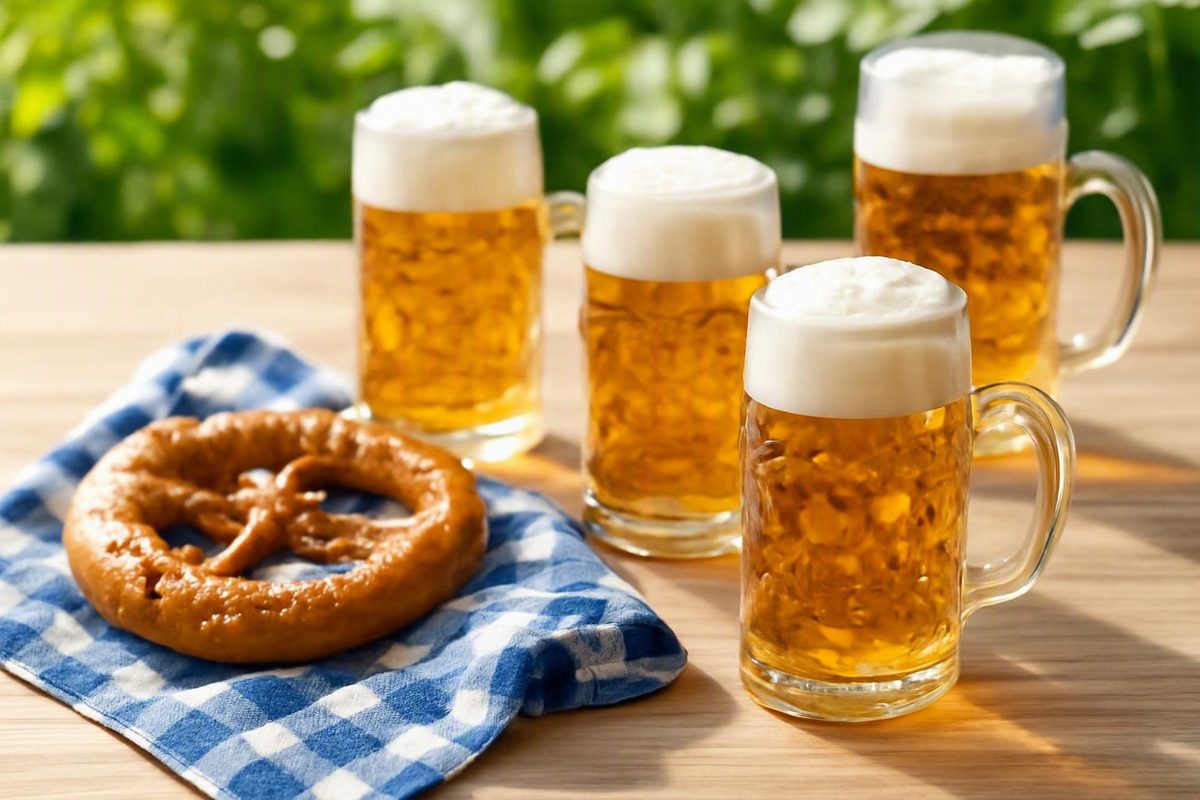
The short answer: what counts as an Oktoberfest beer?
“Bavarian Oktoberfest beer” can mean three related but distinct things:
- Beer supplied to Munich Oktoberfest by one of its six recognized Munich breweries. This is the narrowest and most useful meaning of an official Munich festival beer.
- A seasonal Festbier or Märzen brewed elsewhere in Bavaria. It can be authentically Bavarian and appropriate for an autumn celebration without being poured at Munich Oktoberfest.
- An Oktoberfest-style beer brewed elsewhere. Breweries outside Bavaria—and outside Germany—use the label for beers inspired by the festival, including amber Märzens, pale Festbiers and less formal seasonal interpretations.
The distinction matters because present-day beer in Munich’s festival tents is generally a pale or golden Festbier, not necessarily the amber, toast-forward Märzen many shoppers expect from an Oktoberfest label. Modern beer references distinguish the golden Munich festival pour from the amber Märzen convention still common in export and international craft-beer markets when explaining Oktoberfestbier, Märzen and Festbier.
Oktoberfestbier is therefore more dependable as a designation of origin and festival context than as the name of one immutable style. The beer associated with Oktoberfest has changed over time. A beer recognized as Munich Oktoberfestbier today need not resemble every beer historically served at the festival—or every autumn beer marketed with Oktoberfest imagery abroad.
Wiesn is the common Bavarian name for Munich Oktoberfest and its Theresienwiese setting. It derives from the local word for meadow. Wiesnbier is an informal way of referring to beer associated with the Wiesn, but it should not be treated as a universally standardized style term.
Oktoberfest beer terminology
Term Practical meaning Oktoberfestbier Beer made for and associated with Munich Oktoberfest, especially festival beer from one of the six recognized Munich breweries. The term identifies origin and context more reliably than one fixed color or historical recipe. Festbier Usually a golden lager with clean fermentation, a firm malty base, moderate hop character and a crisp finish. It is the general model for modern Munich festival beer. Märzen Usually an amber-to-copper lager with richer, toastier and breadier malt character. It is historically associated with Oktoberfest and remains common under Oktoberfest branding outside Munich. Wiesnbier An informal term for beer connected with the Wiesn. The word alone does not establish that a product is an official Munich festival pour. Oktoberfest-style beer A beer inspired by the festival but not necessarily brewed in Munich, Bavaria or Germany. It may be a Märzen, Festbier or another seasonal interpretation.
An earlier Around Germany page survives in the Wayback Machine under the title “Bavarian Beers ready for the Oktoberfest”. The available archive preserves the title but not a substantive article body, so it cannot establish which breweries, beers, styles or festival rules that page discussed.
The practical way to navigate the category is to ask four separate questions:
- Where was the beer brewed?
- Which brewery made it?
- What style does the current package identify?
- Is it described as an actual Munich festival pour or only as a seasonal interpretation?
The six Munich breweries associated with Oktoberfest
The six breweries consistently recognized as Munich Oktoberfest suppliers are:
- Augustiner
- Hacker-Pschorr
- Hofbräu
- Löwenbräu
- Paulaner
- Spaten
Festival recognition does not arise merely from being German, following a familiar lager recipe or operating somewhere in Bavaria. It is tied to Munich brewing origin and participation by the established group of traditional Munich breweries. The official Oktoberfest brewery guide names all six and reports brewery histories, selected festival-beer specifications and tent relationships.
Where sources conflict, the comparison below gives a bounded range rather than selecting one figure as timeless. A commercial travel guide, for example, reports some strengths differently from the official festival page, including 6.0% rather than 6.3% for Augustiner and 5.8% rather than 6.0% for Hacker-Pschorr in its brewery comparison.
| Brewery | Documented historical starting point | Reported festival-beer strength | Verified distinguishing fact |
|---|---|---|---|
| Augustiner-Bräu | 1328 | Approximately 6.0%–6.3% ABV | The official festival site describes Augustiner as Munich’s oldest surviving brewery and says its Wiesn beer is served from traditional 200-liter wooden barrels. |
| Spaten | 1397 | No current figure treated as verified here; one secondary guide reports about 5.9% ABV | Associated with the development and marketing of lighter Munich lager, including the early marketing of Münchner Hell. |
| Hacker-Pschorr | 1417 | Approximately 5.8%–6.0% ABV | Its documented roots reach 1417; Hacker and Pschorr later returned to a joint brand. |
| Hofbräu München | 1589 | Approximately 6.3% ABV | Founded as a ducal brewery and later operated as a state-owned enterprise. |
| Paulaner | 1634 | Approximately 6.0% ABV | Its documented origin is associated with the Paulaner monks in Munich. |
| Löwenbräu | Probably the late 14th century; name documented in 1746 | Approximately 6.1% ABV | A late-14th-century origin is described as probable, while the Löwenbräu name appears in Munich’s brewing directory in 1746. |
These dates are historical starting points, not rankings of quality, influence or present-day preference. They also do not mean that every packaged product sold under a brewery’s name is identical to the beer served at the Wiesn.
Augustiner has the earliest firmly stated founding date in the group. Its wooden-barrel service is an unusually visible festival distinction. That fact should not be expanded into unsupported claims about whether every component of a barrel is unlined wood, how the vessels are constructed or why the practice has been retained.
Hacker-Pschorr illustrates why strength figures need careful wording. Published comparisons place its festival beer at either 5.8% or 6.0% ABV. Reporting the range is more accurate than choosing one number and implying that it applies across all years and markets.
Hofbräu began as a ducal brewery in 1589. The official festival material reports a 6.3% Wiesn beer and identifies the brewery’s later state-owned status.
Paulaner traces its origin to 1634, and approximately 6.0% ABV is repeated in the available accounts for its Munich festival beer. That is best treated as a reported festival specification, not a promise that every Paulaner Oktoberfest product in every market has the same recipe or strength.
Löwenbräu requires more careful historical language than a simple founding-year list suggests. One account describes a late-14th-century beginning as probable, while the brewery name is recorded in Munich’s brewing directory in 1746. Its festival beer is commonly reported at about 6.1% ABV.
Spaten dates to 1397 and is closely associated with Munich lager history, including the early marketing of Münchner Hell. Because the available official material does not provide a complete current Spaten festival-beer entry, a current strength should not be presented here as definitively verified.
Together, the six form the brewery group recognized by the official Munich festival. That status does not mean they produce beers with identical color, flavor, strength, packaging or export strategy. Nor does it make Bavarian beers from outside the group inauthentic. It means only that an official Munich Oktoberfest pour belongs to a narrower category than Bavarian festival beer generally.
Festbier versus Märzen: the difference in the glass
Present-day Munich Oktoberfest tents generally serve golden Festbier. Amber Märzen remains strongly associated with the festival’s late-19th-century history and with many Oktoberfest-branded beers sold abroad.
The styles are related malt-led lager traditions rather than opposites. The easiest visual distinction is that Festbier is usually pale to gold, while Märzen is normally amber to copper. In flavor, Märzen emphasizes toasted malt richness; Festbier aims for a lighter and crisper balance.
| Characteristic | Festbier | Märzen |
|---|---|---|
| Color | Pale gold to deeper gold | Amber to copper |
| Malt character | Clean grain, fresh bread, light honey or biscuit; substantial but not heavily toasted | Richer bread crust, toast and deeper malt; sometimes light caramel-like impressions |
| Hop character | Floral, herbal or spicy Noble-hop character may be more noticeable | Usually restrained and supportive of the malt |
| Body | Medium and comparatively smooth or light in impression for its strength | Medium to moderately full, often perceived as richer |
| Finish | Crisp, balanced and generally dry enough to remain refreshing | Malt-led but normally dry rather than sticky |
| Typical strength | About 6%–6.5% ABV | Roughly 5%–6% ABV |
| Modern Munich role | General present-day tent profile | Historical festival association rather than the usual modern tent profile |
| Common international role | Used by breweries seeking a pale Munich-inspired release | Common form of Oktoberfest-branded beer in export and craft-beer markets |
These are generalized ranges, not rigid limits. Individual products can fall outside them, and breweries do not apply the terminology consistently across all markets. A beer-style discussion describes Märzen at roughly 5%–6% ABV and Festbier at about 6%–6.5%, while emphasizing the contrast between amber international releases and modern pale Munich pours in its comparison of the two lager types.
Märzen takes its name from March. Historically, beer brewed around that period could be conditioned through the warmer months for autumn service. In contemporary style language, the name usually indicates an amber lager with a prominent malt center: toasted bread, crust and clean grain rather than roasted coffee or burnt flavors. Bitterness is restrained, and the finish should prevent the malt from becoming cloying.
Festbier is normally golden and lighter in impression, although not necessarily lower in alcohol. It can resemble a stronger, more malt-substantial pale Munich lager. Hop aroma and flavor may be somewhat more noticeable than in Märzen, commonly appearing floral, herbal or spicy rather than citrus-heavy or aggressively bitter.
“Lighter” therefore needs context. With Festbier, it generally means lighter in color and malt richness, not automatically light in alcohol. A golden lager around 6% ABV may taste crisp while still being stronger than its pale appearance suggests.
Neither style is objectively better. Märzen suits drinkers who want amber color and deeper toasted malt. Festbier suits those who prefer a paler, cleaner and crisper lager with enough malt to avoid tasting thin. The choice is about desired flavor, not authenticity points.
An Oktoberfest label alone does not settle the question. A brewery may sell a pale festival beer in Germany and an amber Märzen or related seasonal lager in another market. Before buying, check the style name, color description, alcohol level, brewery location and current product information.
How Oktoberfest beer changed from dark lager to golden Festbier
Oktoberfest did not begin as a festival created to showcase a particular beer style. It began in 1810 as a public celebration of the marriage of Crown Prince Ludwig and Princess Therese. The celebration was repeated, lengthened and moved earlier in the calendar so more of it could take place in favorable September weather, as summarized in the American Homebrewers Association’s history of the festival and its beer.
The broad progression is well supported:
- Dark lager in the early festival period
- Amber lager and Märzen during the 19th and much of the 20th century
- Pale golden Festbier as the later modern norm
Precise transition dates are less secure. Historical summaries do not always distinguish among a beer’s first appearance, its commercial promotion, adoption by one brewery and eventual dominance across the festival.
| Date or period | Confidence | What can reasonably be said |
|---|---|---|
| 1810 | Established context | Oktoberfest began with a royal wedding celebration, not as a dedicated Märzen or Festbier event. |
| Early 19th century | Established broad progression | Dark lager characterized the period before lighter malts and lager colors became widespread. |
| 1841 | Source-dependent detail | One account associates this year with Spaten introducing a lighter amber lager. It should not be treated as the moment Märzen became universal across the festival. |
| Around 1870–1872 | Strong association, disputed precision | Märzen or an amber Vienna-influenced lager became strongly associated with Oktoberfest. The often-repeated 1872 story does not prove an instantaneous festival-wide change. |
| Mid-1960s | Source-dependent transition date | One modern beer history places the beginning of Paulaner’s pale festival-beer transition in this period. |
| Early 1970s | Source-dependent transition date | Another account places the debut or decisive rise of golden Festbier here. |
| Later 20th century | Established broad outcome | Pale Festbier became the normal modern beer in Munich’s festival tents. |
| By the 1990s | Source-dependent completion claim | One summary describes festival-wide adoption as complete by this point, although the brewery-by-brewery sequence is not established. |
The source-dependent dates of 1841, 1872, the early 1970s and the 1990s appear in one modern history of Oktoberfest beer, but its neat sequence should be read as a summary rather than definitive proof of simultaneous adoption across all breweries in its published timeline. A separate beer magazine instead places Paulaner’s transition toward golden Festbier in the mid-1960s, demonstrating why the date is better presented as a range than as a settled turning point in its account of the style’s evolution.
The uncertainty does not undermine the central conclusion. Munich’s festival beer changed as malt production, brewing technology, brewery practice and drinkers’ preferences changed. Oktoberfestbier has never been frozen permanently in one color.
An amber lager visually signals autumn and offers a profile distinct from an everyday pale lager.
Some explanations claim Festbier replaced Märzen solely so visitors would consume more beer. The available evidence does not establish that motive. A paler, crisper beer may be perceived as easier to drink, but that does not prove a single commercial intention or explain a gradual, brewery-by-brewery transition.
The history also explains why arguments about the “real” Oktoberfest style often go in circles. Someone picturing the late-19th-century festival may reasonably imagine amber Märzen. A visitor describing a present-day Munich tent may correctly picture golden Festbier. A shopper in another country may find both under Oktoberfest branding.
Official Munich beer versus other authentic Bavarian festival beers
“Bavarian,” “Festbier” and “official Munich Oktoberfest beer” overlap, but they are not interchangeable.
- Bavarian describes regional origin.
- Festbier describes a festival-oriented beer, usually a lager in this context.
- Official Munich Oktoberfest beer describes beer supplied to the Munich festival by its recognized brewery group.
A brewery outside Munich can produce a genuine Bavarian Märzen or Festbier. Its beer may be regionally authentic, traditionally made and well suited to an Oktoberfest-season tasting. It still does not become one of the recognized Munich festival pours.
| Category | Likely origin | Expected style | One of the recognized Munich festival pours? |
|---|---|---|---|
| Official Munich Oktoberfestbier | Munich; one of the six recognized breweries | Usually modern golden Festbier | Yes |
| Bavarian Festbier outside the six | Bavaria, outside the recognized Munich group | Usually golden seasonal lager | No |
| Bavarian Märzen outside the six | Bavaria, outside the recognized Munich group | Usually amber, malt-led lager | No |
| Bavarian festival wheat beer | Bavaria | Wheat beer rather than Festbier or Märzen lager | No |
| German Oktoberfest-style beer outside Bavaria | Elsewhere in Germany | Festbier, Märzen or another seasonal lager | No |
| International Oktoberfest-style beer | Outside Germany | Often Märzen; sometimes Festbier or a hybrid interpretation | No |
| Unspecified autumn seasonal beer | Anywhere | Cannot be inferred from imagery alone | No evidence of official status |
Weihenstephaner Festbier is a clear example of a Bavarian seasonal lager outside the recognized six.
Ayinger Festmärzen, brewed in Aying, is a useful example of a Bavarian Märzen outside the Munich group. A published tasting identifies the beer as brewed in Aying and distinguishes it from the Munich festival suppliers while reviewing Oktoberfest-season releases.
Schneider Festweisse belongs in another category. It is a festival-themed Bavarian wheat beer rather than a bottom-fermented Festbier or Märzen lager. Its wheat and yeast character can add contrast to a tasting, but it should be identified as Festweisse or wheat beer rather than presented as the standard modern Munich festival style. A commercial Bavarian beer list likewise classifies Schneider Festweisse as a golden wheat beer and Weihenstephaner Festbier as a seasonal lager in its product descriptions.
This taxonomy prevents several common mistakes:
- Not every German beer is Bavarian.
- Not every Bavarian beer is a festival beer.
- Not every Bavarian Festbier or Märzen is an official Munich Oktoberfest pour.
- Autumn leaves, lederhosen or blue-and-white diamonds do not prove Bavarian origin.
- A beer labeled Oktoberfest is not necessarily amber.
- A beer labeled Festbier does not necessarily match the precise beer poured at the Wiesn.
Purity-law language does not resolve the issue. A simplified statement about barley, hops and water is neither a complete account of German brewing law nor proof of Munich festival participation. Brewery identity, Munich origin and recognition by the festival are more practical tests.
For a home tasting, both official-six products and broader Bavarian seasonal beers can be useful. Label them honestly as “recognized Munich brewery,” “Bavarian seasonal beer outside the six” or “international Oktoberfest-style interpretation.”
How to choose a Bavarian Oktoberfest-season beer
There is no need to rank breweries to make a useful choice. Start with the flavor you want, then verify the beer’s origin and current specification.
If you want to approximate the modern Munich tent profile:
- Look for Festbier wording.
- Expect a pale or golden color.
- Look for descriptions such as crisp, clean, bready, lightly honeyed, floral, herbal or spicy-hopped.
- Expect strength to be near 6% ABV rather than ordinary light-beer territory.
- Check whether the product is identified specifically as a festival, German-market or export release.
If you want the richer style historically associated with Oktoberfest:
- Look for Märzen on the package or product page.
- Expect an amber or copper color.
- Look for toasted bread, bread crust, biscuit or rich malt descriptions.
- Choose a dry or balanced example if you want malt depth without excessive sweetness.
- Do not dismiss it as inauthentic merely because it differs from the modern pale Munich pour.
If you want broader Bavarian variety:
- Consider Weihenstephaner Festbier as a Bavarian golden seasonal lager outside the official six.
- Consider Ayinger Festmärzen as an amber Bavarian seasonal lager outside the six.
- Include Schneider Festweisse only when you specifically want a festival-themed wheat beer.
- Add a dunkel, helles or another Bavarian style for contrast, but keep its proper style name.
A practical shopping checklist is more reliable than front-label imagery:
- Style name: Does it say Festbier, Märzen, lager, wheat beer or something else?
- Color: Is it described as pale gold, deep gold, amber or copper?
- ABV: Does the strength suit the way you intend to serve it?
- Brewery location: Is the brewery in Munich, elsewhere in Bavaria, elsewhere in Germany or abroad?
- Festival status: Does a reliable source actually say the beer is poured at Munich Oktoberfest?
- Market version: Is it a domestic German release, an export-specific product or a locally brewed brand version?
- Date: Is the specification current, or does it come from an old retailer listing?
Paulaner, Hacker-Pschorr, Hofbräu and Spaten are recognizable reference points, but their names alone do not prove that a bottle in one country is identical to its Wiesn counterpart. Published product coverage has, for example, distinguished an amber Spaten export Märzen from the golden Oktoberfestbier associated with Germany. The broader rule is simple: festival pour, domestic package and export product should be treated as potentially different until current product information confirms equivalence.
Availability is also market-dependent. A beer common in one country may be seasonal, allocated, reformulated or absent in another. Instead of building a tasting around an assumed product list, begin with categories:
- One or more beers from recognized Munich breweries
- A golden Bavarian Festbier outside the six
- An amber Bavarian Märzen outside the six
- An optional wheat beer, dunkel or helles for contrast
A simple three-beer comparison could include:
- A pale Festbier from a recognized Munich brewery
- A Bavarian Märzen from outside the official six
- A festival-themed wheat beer or another clearly labeled German style
Taste them in that order, moving from the cleanest pale lager toward richer malt or more expressive yeast character. Compare color, aroma, malt depth, hop presence, body and finish. The purpose is not to crown a winner but to understand how much territory the phrase “Oktoberfest beer” can cover.
Helles, dunkel, Weissbier, bock and other German or Bavarian styles can all suit a themed event. They should simply retain their proper names. A dunkel does not become Märzen because it is served in September, and a wheat beer does not become modern Oktoberfest lager because its branding looks festive.
Beer, tents, and the opening of the Munich festival
Munich Oktoberfest is a folk festival, not merely a large beer tasting. Beer halls share the Theresienwiese with Bavarian food, music, parades, rides, games and other attractions. The event is normally held from mid-September into early October, although visitors should check the dates for the relevant year.
The festival opens with a formal beer ritual. Munich’s mayor taps the first keg and declares “O’zapft is!”—“It is tapped”—before general beer service begins. The mayoral keg tapping has opened the festival since 1950, according to the published history and overview of Munich Oktoberfest.
Brewery choice is connected to the visitor experience because major tents are associated with particular breweries. Choosing a tent therefore often determines which beer arrives in the Maß.
Well-supported examples include:
- Hofbräu at the Hofbräu Festzelt
- Augustiner at the Augustiner Festzelt and Fischer-Vroni
- Hacker-Pschorr in tents associated with Hacker and Bräurosl
Augustiner’s traditional wooden-barrel service is especially distinctive in this setting. It creates a visible connection between brewery identity and festival service without establishing that the beer is objectively better.
Tent relationships should nevertheless be treated as year-sensitive. Names, operators, specialty venues and assignments can change, and broad claims that every venue always follows an exceptionless one-brewery rule may overstate the evidence. Anyone planning around a particular beer should consult the current festival’s tent information.
The same restraint applies to atmosphere. Brewery identity does not prove that one tent will always be quieter, more traditional, more local or more enjoyable. Conditions can vary by day, time, reservation area, music program and crowd.
For visitors who care most about the beer, a useful planning sequence is:
- Confirm the brewery associated with the desired tent for that year.
- Check the current reservation arrangements.
- Verify the current beer specification if strength matters.
- Remember that the experience includes food, music and shared tables—not only sensory comparison.
- Keep alternative tents in mind rather than relying on one undated assignment.
For hosts at home, tent associations can inspire a tasting without pretending to reproduce Munich exactly. Group beers by brewery, serve food at shared tables and use short style cards to distinguish official-six products from broader Bavarian seasonal beers.
Serving Oktoberfest beer responsibly
A Maß is a one-liter serving—equal in volume to two 500-milliliter bottles, not twice their combined volume. Published festival comparisons place the recognized Munich beers at approximately 5.8%–6.3% ABV, although individual figures can vary by beer, year and source; the same guide identifies a Maß as one liter in its overview of the six breweries.
The alcohol-volume calculation is straightforward:
- Serving volume: 1,000 milliliters
- Alcohol by volume: 6%
- Pure alcohol by volume: 1,000 × 0.06 = 60 milliliters
One liter of beer at 6% ABV therefore contains approximately 60 milliliters of pure alcohol by volume. This is a mathematical volume estimate, not a universal standard-drink count.
Pale color and a crisp finish do not indicate low alcohol. A golden Festbier near 6% ABV, served by the liter, combines substantial strength with a large serving format.
Practical risk-reduction steps include pacing the serving, having food and water available, providing non-alcoholic options, avoiding drinking contests and arranging transport that does not depend on a guest driving after drinking. Home-party guidance also emphasizes communal drinking rather than competitive consumption when outlining an Oktoberfest-style gathering. These are general planning suggestions, not individualized medical advice; applicable public-health guidance and advice from a qualified health professional should take priority.
A fixed number of Maß servings cannot be declared appropriate for everyone. Serving strength, drinking time and personal circumstances vary, while countries use different standard-drink definitions.
Food pairings can remain flexible:
- Crisp Festbier can complement roast chicken, pretzels, Weißwurst or schnitzel.
- Maltier Märzen can suit bratwurst, roast pork or Obatzda.
- Festweisse or another wheat beer can work with lighter dishes or foods that suit a more aromatic, yeast-driven beer.
These are practical serving ideas, not official brewery rules. A tasting should also include water, non-alcoholic choices and enough food for the length of the gathering.
The distinction that resolves most confusion is simple: Munich Oktoberfest pours come from six recognized Munich breweries and are now generally golden Festbiers. Amber Märzens and other Bavarian festival beers belong to a broader seasonal tradition.
Choose by verified origin, style, color and ABV rather than label imagery alone. Treat festival and export products as potentially different, and remember that a crisp beer served in a one-liter Maß can still carry considerable strength.
What are the six official Munich Oktoberfest breweries?
They are Augustiner, Hacker-Pschorr, Hofbräu, Löwenbräu, Paulaner and Spaten. These are the six traditional Munich breweries recognized by the official festival as its beer suppliers.
A brewery’s location elsewhere in Bavaria is not enough to place it in this group. “Official Munich Oktoberfest beer” is narrower than “Bavarian beer” or “Bavarian Festbier.”
Is the beer at Munich Oktoberfest a Märzen or a Festbier?
Present-day Munich tents generally pour golden Festbier. It is typically crisp, malt-supported and somewhat more hop-present than the richer amber lager many people associate with Oktoberfest.
Märzen remains historically connected to the festival and is common among Oktoberfest-branded beers sold abroad. It is generally amber to copper, toastier and more malt-focused. Check the individual product rather than assuming every Oktoberfest label means the same style.
Are Ayinger and Weihenstephaner official Oktoberfest beers?
No. Ayinger and Weihenstephaner are not among the six recognized Munich Oktoberfest breweries.
Ayinger Festmärzen and Weihenstephaner Festbier can still be authentic Bavarian seasonal beers. They are appropriate for a broader Bavarian tasting but should not be described as recognized Munich Oktoberfest pours.
Are Oktoberfest beers sold outside Germany the same as the beers poured in Munich?
Not necessarily. An export beer can differ from a Wiesn pour in style, color, strength, recipe or packaging. Some international products emphasize amber Märzen even when the corresponding modern Munich festival beer is golden Festbier.
Check the exact product name, style, ABV, brewery location and current product information. Do not assume equivalence solely because the package displays a recognized brewery name or the word Oktoberfest.
How much alcohol is in a one-liter Maß of Oktoberfest beer?
At 6% ABV, a one-liter Maß contains approximately 60 milliliters of pure alcohol by volume:
1,000 ml × 0.06 = 60 ml
Recognized Munich festival beers are commonly reported around 5.8%–6.3% ABV, and a Maß is a one-liter serving, so the precise alcohol volume depends on the beer reported in this comparative festival guide. The calculation is not a universal standard-drink count. A Maß is a large serving, and pale color or crisp flavor does not make it low in alcohol.